


Why Industrial Training Is Broken - And What Comes Next

Industrial training is not evolving slowly.
It is breaking under the weight of modern industrial complexity.
For decades, companies relied on classroom sessions, static manuals, and on-the-job shadowing to train operators and technicians. That model worked when systems were simpler, teams were local, and the cost of mistakes was manageable.
That reality no longer exists.
Today’s industrial organizations operate across geographies. Equipment is more complex, systems are interconnected, and the cost of operational errors is significantly higher.
This is not just a training problem. It is a structural limitation.
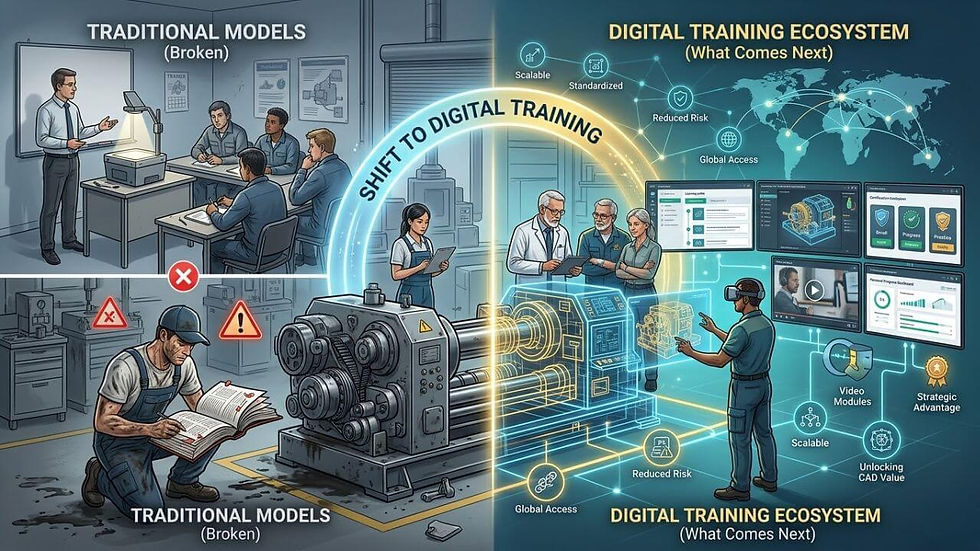
The Core Problem with Traditional Industrial Training
Traditional industrial training fails not because it is outdated, but because it cannot operate at industrial scale.
Three patterns consistently emerge.
First, training does not scale. Programs struggle to expand across locations, teams, and customer environments without introducing variability.
Second, knowledge transfer becomes inconsistent. Different trainers and formats lead to different interpretations, making outcomes unpredictable.
Third, risk increases. Operators often learn by interacting with real equipment, where mistakes are costly.
These gaps create a clear mismatch between how training is delivered and how modern industrial operations actually function.
The Shift to Digital Industrial Training
Industrial organizations are now moving toward structured, digital training systems that are designed for scale.
Instead of isolated sessions, training is becoming continuous, standardized, and integrated into daily operations.
Digital learning environments provide consistency. Simulation-based training enables safe, hands-on experience. Integrated platforms connect learning, practice, and certification into a single flow.
This shift is not about tools. It is about how industrial knowledge is created, managed, and distributed.
Training as a Core Operational Capability
Training is no longer just an internal support function.
It directly influences safety, efficiency, and customer outcomes.
In complex industrial environments, the way people are trained determines how effectively systems are used and maintained. Poor training leads to errors, downtime, and inconsistent performance.
Organizations that invest in modern training systems are not just improving learning.
They are strengthening their entire operational foundation.
What Is a Digital Training Ecosystem?
Industrial training is moving toward integrated ecosystems rather than standalone tools.
A digital training ecosystem connects three essential layers.
A training management layer ensures control over users, certifications, and compliance.
A digital learning layer delivers structured, interactive knowledge.
A simulation layer enables hands-on experience in a controlled environment. The real value lies in how these layers work together.
A learner can move seamlessly from understanding a concept to practicing it and then getting certified, all within a unified system. This continuity is what makes training scalable and effective.
Unlocking the Value of Engineering Data
Most industrial companies already possess the raw material required to transform training.
They have detailed engineering assets, including CAD models, documentation, and product structures. Yet these assets are rarely used in training environments.
The reason is simple. CAD data is complex, heavy, and not designed for interaction.
As a result, training teams often rebuild simplified versions of the same information.
The opportunity lies in rethinking this approach.
By converting engineering data into interactive formats, companies can create simulation environments, digital twins, and immersive training modules. This bridges the gap between engineering and learning, allowing users to interact with systems rather than just read about them.
Why Simulation Is Becoming Essential
Industrial training becomes effective when it is experiential.
People learn faster and retain more when they can interact with systems directly. However, real-world training is expensive, risky, and difficult to scale.
Simulation changes this equation.
It creates a safe environment where users can explore systems, practice procedures, and learn from mistakes without real-world consequences.
This leads to faster onboarding, more consistent outcomes, and significantly reduced operational risk.
Simulation is no longer a supplementary tool. It is becoming a foundational component of industrial training systems.
A Strategic Shift for OEMs
Training has traditionally been treated as a support activity, often reactive and cost-driven.
That perspective is changing.
Forward-looking OEMs are recognizing training as a strategic capability. Instead of limiting it to internal use, they are building structured programs that extend to customers and partners.
This includes certification pathways, role-based learning journeys, and simulation-driven experiences.
The impact is measurable. Customers adopt systems more effectively, support costs decrease, and new revenue models begin to emerge.
Training, in this context, becomes part of the product experience itself.
The Future of Industrial Training
Industrial training is moving toward integrated, intelligent ecosystems that combine digital learning, simulation, and engineering data.
These systems enable organizations to train globally with consistency, reduce risk across operations, and scale knowledge efficiently.
This is not a gradual improvement. It is a fundamental shift in how industrial capability is built.
Conclusion
Training is no longer a support function. It is becoming part of the product itself.
It defines how systems are understood, operated, and scaled.
In a world where industrial complexity continues to increase, the ability to train effectively will separate leaders from followers.
The companies that recognize this shift early will not just improve training. They will redefine how industrial systems are delivered, experienced, and maintained.
FAQ
Q1. Why is industrial training broken today?
Industrial training is broken because traditional methods cannot scale, ensure consistent knowledge transfer, or safely train operators on complex systems. Modern industrial environments require digital and simulation-based approaches.
Q2. What is a digital training ecosystem?
A digital training ecosystem is an integrated system that combines training management platforms, digital learning environments, and simulation-based training to deliver structured and scalable learning.
Q3. What is simulation-based training in manufacturing?
Simulation-based training allows operators to practice real-world industrial scenarios in a safe virtual environment, improving learning outcomes and reducing operational risks.
Q4. How can industrial companies improve workforce training?
Industrial companies can improve training by adopting digital platforms, standardizing processes, integrating simulations, and using engineering data like CAD models.
Q5. Why is consistency important in industrial training?
Consistency ensures that all operators receive the same level of training, reducing errors, improving safety, and maintaining operational standards across locations.
Q6. How do digital training systems reduce operational risk?
Digital training systems allow users to practice procedures in a controlled environment, reducing the risk of equipment damage and safety incidents.
Q7. What role do CAD models play in training systems?
CAD models can be converted into interactive simulations and digital twins, enabling immersive and practical training experiences.
Q8. What is the future of industrial training?
The future of industrial training lies in integrated digital ecosystems that combine simulation, real-time data, and scalable learning platforms.