

Multi-Agent Systems for Enterprise AI
Enable Collaboration Between AI Agents Across Workflows
Multi-agent systems are AI architectures where multiple intelligent agents work together to execute tasks, solve problems, and manage workflows across enterprise environments.
As business processes become more complex, single-system automation is no longer sufficient. Organizations need distributed intelligence that can operate across systems and functions.
EC Infosolutions designs multi-agent systems that enable coordination, collaboration, and scalable execution across enterprise workflows.
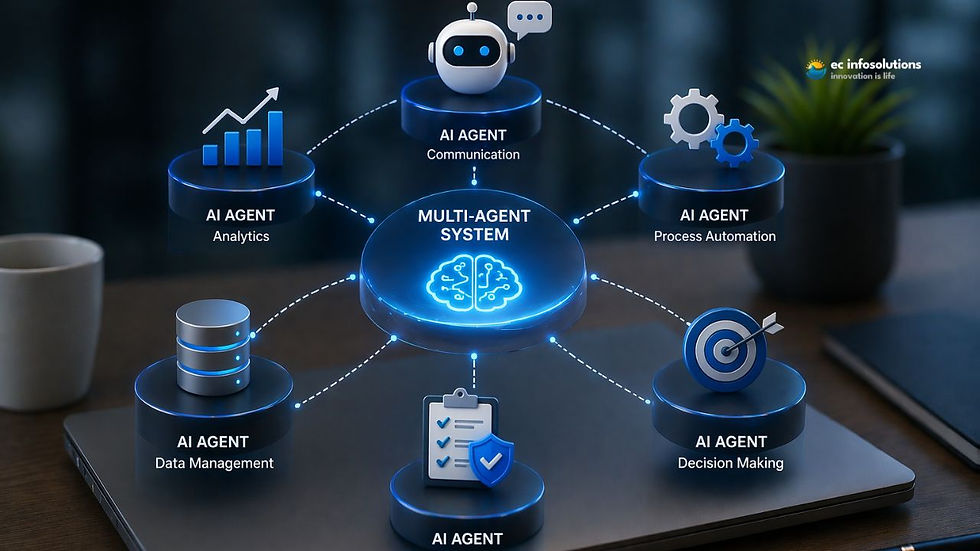
What are Multi-Agent Systems
Multi-agent systems consist of multiple AI agents that operate independently while collaborating to achieve shared objectives.
Each agent is designed for a specific function, such as data processing, decision-making, or workflow execution.
👉 Multi-agent systems enable distributed intelligence across enterprise systems.
Agent Collaboration and Coordination
AI agents communicate with each other, share data, and coordinate actions to complete complex workflows.
This collaboration enables tasks to be distributed across agents, improving efficiency and flexibility.
👉 Coordinated agents can execute workflows that are too complex for single systems.
Distributed Intelligence Across Systems
Multi-agent systems operate across multiple systems, environments, and data sources such as ERP, CRM, APIs, and cloud platforms.
This allows intelligence to be distributed rather than centralized.
👉 Distributed systems improve scalability, resilience, and performance.
Enterprise Use Cases for Multi-Agent Systems
Multi-agent systems are used in various enterprise scenarios including operations management, supply chain coordination, financial workflows, and automation systems.
They are particularly effective in environments that require real-time decision-making and coordination across multiple systems.
👉 Multi-agent systems enable intelligent automation at scale.
Business Impact of Multi-Agent Systems
Multi-agent systems improve scalability, enable intelligent collaboration, and enhance automation across enterprise operations.
Organizations can execute complex workflows efficiently while maintaining flexibility and control.
AI Agents for Business Automation
AI Integration & Enterprise Systems
FAQ
Q1. What are multi-agent systems in AI?
Multi-agent systems are architectures where multiple AI agents work together to perform tasks and solve problems.
Q2. How do multi-agent systems work?
Each agent performs specific tasks and communicates with other agents to coordinate actions and complete workflows.
Q3. What are the benefits of multi-agent systems?
They improve scalability, enable distributed intelligence, and support complex workflow execution.
Q4. Where are multi-agent systems used?
They are used in operations, supply chain management, finance, automation, and enterprise AI systems.
Q5. How are multi-agent systems different from single-agent systems?
Single-agent systems operate independently, while multi-agent systems involve collaboration between multiple agents.
Q6. Why are multi-agent systems important for enterprises?
They enable scalable, flexible, and intelligent automation across complex enterprise environments.